Invented by Chiong; Hendrich, Shaver; Ronald
Patent applications can be long and technical, but they often hold the key to real-world solutions. Today, we are breaking down a recent patent application for a process and device that uses special polymer composites to remove tiny contaminants from fluid streams. We will guide you through the story behind this innovation, the science that led to it, and how it stands out from what came before.
Background and Market Context
Let’s start with why this invention matters. In industries where fluids flow—like water treatment, food and beverage, pharmaceuticals, chemicals, oil and gas, and pulp and paper—there is a big need to keep these fluids pure. Even small amounts of metals, proteins, or chemicals in these fluids can cause big problems. They may hurt the quality of the final product, break equipment, or even create safety or health risks. In some cases, these contaminants are valuable metals, such as rhodium or platinum, that are lost if not collected.
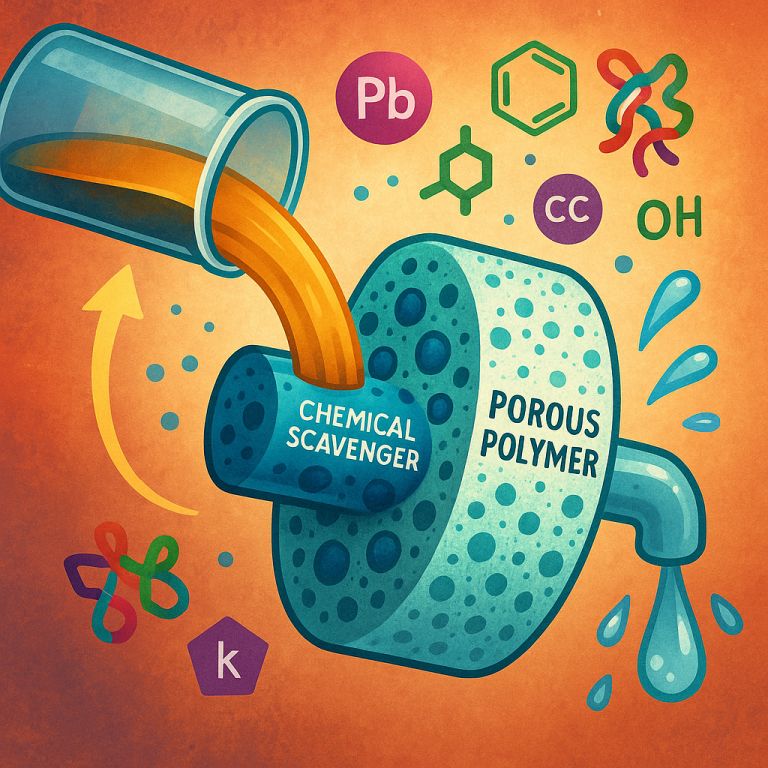
Traditionally, companies have tried to clean up their processes using chemical scavengers. These are special molecules that “grab” certain unwanted substances from the fluid. Often, these scavengers come as tiny particles that are packed into cartridges or beds. When the fluid passes through, the scavengers pull out the bad stuff. But, using loose small particles creates some headaches. They can cause high pressure drops, making pumps work harder and use more energy. The small particles are also dusty, hard to handle, and sometimes limit how fast the fluid can flow through the filter. This leads to higher costs and more maintenance.
Some have tried to solve this by making the scavenger into larger, solid shapes—like disks or sheets. These are easier to handle, but they don’t always have enough surface area or the right flow features for every type of process. As industries look for more efficient, safer, and faster ways to filter fluids, the need for a smarter, more flexible solution has never been greater.
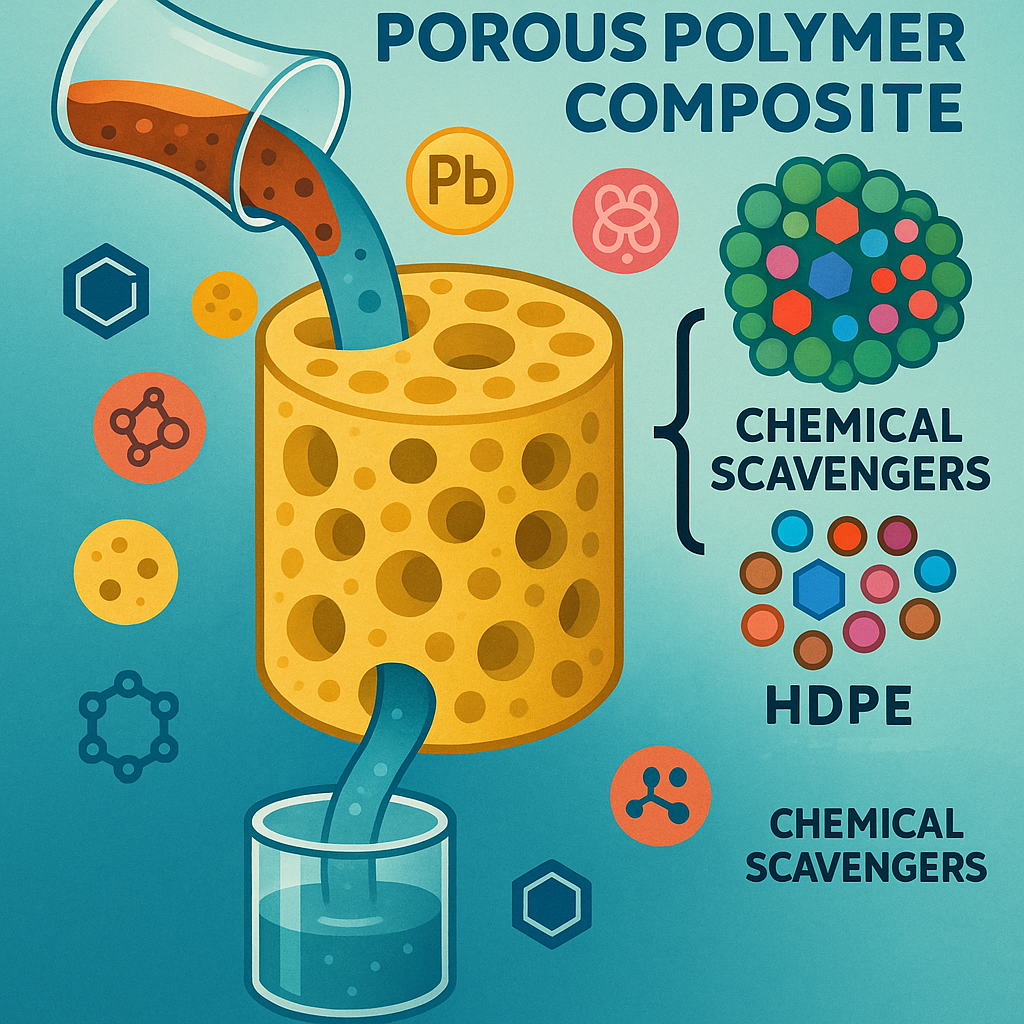
This is where the new patent comes in. It describes a porous polymer composite filter element that can be molded into many shapes and sizes. These new filters are tough, easy to use, and can hold a lot of scavenger inside a solid, porous structure. This means better contaminant removal, less dust, and simpler handling, all while keeping energy costs down.
Scientific Rationale and Prior Art
To understand how this new invention works, we need to look at the science of filtration and scavenging. Filters clean fluids by letting the “good” stuff pass through while trapping the “bad” stuff. Chemical scavengers are like magnets for certain contaminants—they bind or react with specific ions, metals, or organic molecules, pulling them out of the fluid.
For years, the industry has used chemical scavengers that are either loose particles or held inside rigid shapes. These scavengers can target metals like rhodium, palladium, platinum, iron, copper, or mercury, or even proteins and polyphenols. The challenge has always been to get the scavenger in contact with as much fluid as possible, while making the system easy to use and tough enough for industrial needs.
Patent literature shows attempts to embed scavengers in rigid bodies, like those described in U.S. Pat. No. 9,215,891. These bodies are made from materials like polyvinyl polypyrrolidone (PVPP), shaped into disks, sheets, or tubes. While these shapes solve some handling issues, they don’t always provide enough surface area or flexibility for different processes. Other approaches use fixed beds of small particles, but these have the problems of dust, high pressure drops, and difficulty handling.

What has been missing is a way to combine the flexibility of molded shapes with high scavenger loading and great flow-through properties. The goal is to make a filter that is easy to mold, can fit many devices, holds a lot of scavenger, and still lets fluids flow easily for high efficiency.
This new patent recognizes these issues and builds on them. It uses high molecular weight thermoplastic polymers—like ultra-high molecular weight polyethylene (UHMWPE)—as a binder. These polymers are sintered (heated and pressed so they stick together without melting), trapping the scavenger inside a tough, porous structure. The sintering process creates a filter with many tiny passages for fluid, ensuring lots of contact between the scavenger and the contaminants.
Prior art also struggled to load enough scavenger into the filter without making it too weak or too dense. The new patent finds that by carefully choosing the size, shape, and density of the polymer particles, and by using certain types of scavengers (sometimes attached to solid carriers like silica), it’s possible to make a strong, highly porous filter with lots of active scavenger inside.
To sum up, the science and previous inventions paved the way, but they left gaps. The new patent fills those gaps by making filters that are both flexible in shape and highly effective at removing unwanted materials from industrial fluids.
Invention Description and Key Innovations
At the heart of this patent is a process and device for removing contaminants from fluids using a special porous polymer composite. Let’s break down what makes this invention unique:
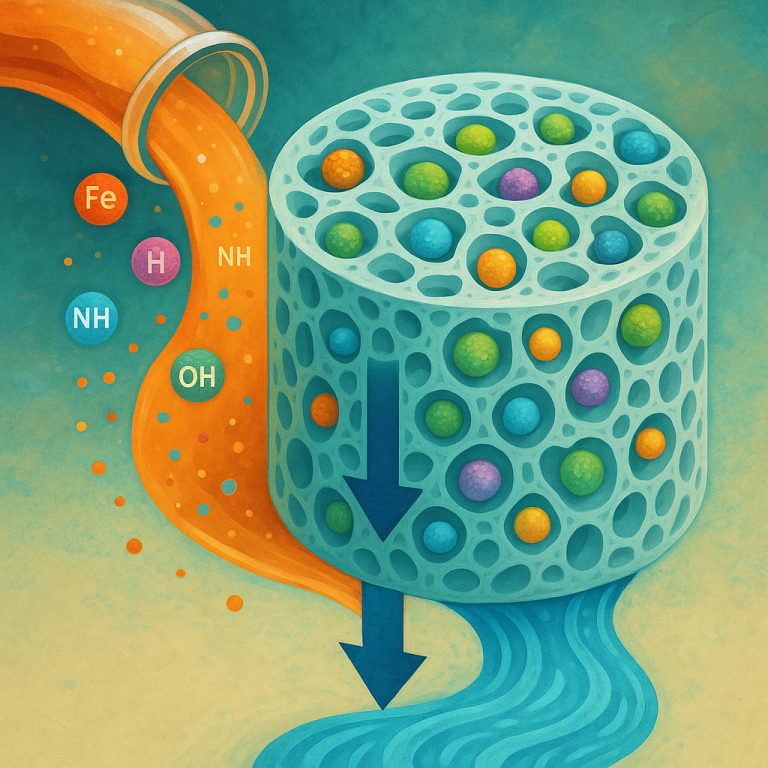
First, the filter element is made by combining thermoplastic polymer particles (like UHMWPE or polyphenylene sulfide) with a chemical scavenger. The polymer acts as a binder. The particles are sintered together to form a solid but porous shape—the pores are just the right size for fluid to move through easily, but small enough to keep the scavenger available for contact.
Unlike flat sheets or tubes, these filter elements can be molded into three-dimensional shapes, such as cylinders, spheres, or even irregular forms. This non-planar design boosts the surface area and makes the filters fit better in cartridges or beds.
The scavenger itself can be almost anything that binds to unwanted ions or molecules. The patent mentions polyvinyl lactams (like PVPP), polybenzimidazole, aminoalkyl compounds, mercaptoalkyl compounds, thioureas, imino diacetates, aminomethyl phosphonic acids, benzyl amines, imidazoles, amines, thiols, and more. For even more flexibility, these scavengers can be loaded onto solid carriers like silica, alumina, zeolite, or clay, then packed into the polymer matrix.
A key advantage is that these filters can be made with a very high amount of scavenger—sometimes over 40% by weight. That means more contaminants can be removed before the filter needs to be changed or regenerated. The porous structure is carefully designed: porosity can be over 10%, with pore sizes greater than 4.5 nanometers, and surface areas that allow plenty of contact with the fluid.
The patent describes several ways to further tune the filter’s performance. For example, using a mix of large and small polymer particles creates a bimodal pore size distribution, improving flow and scavenger availability. Adding leaching agents, like sodium chloride, which are later washed out, can increase porosity even more.
These filter elements can be loaded loose into a cartridge, forming a “fixed bed” through which the fluid flows. This design allows for easy replacement, cleaning, or regeneration. When the scavenger is saturated, the contaminant can be removed and even recovered, using processes like incineration or chemical regeneration.
The invention is not limited to one industry. It works in water treatment, food and beverage (like removing polyphenols from beer), pharmaceutical manufacturing (removing metal catalysts), oil and gas, and chemical processing. It’s especially good at grabbing precious or heavy metals from process streams, which can then be recovered and reused, saving money and reducing waste.
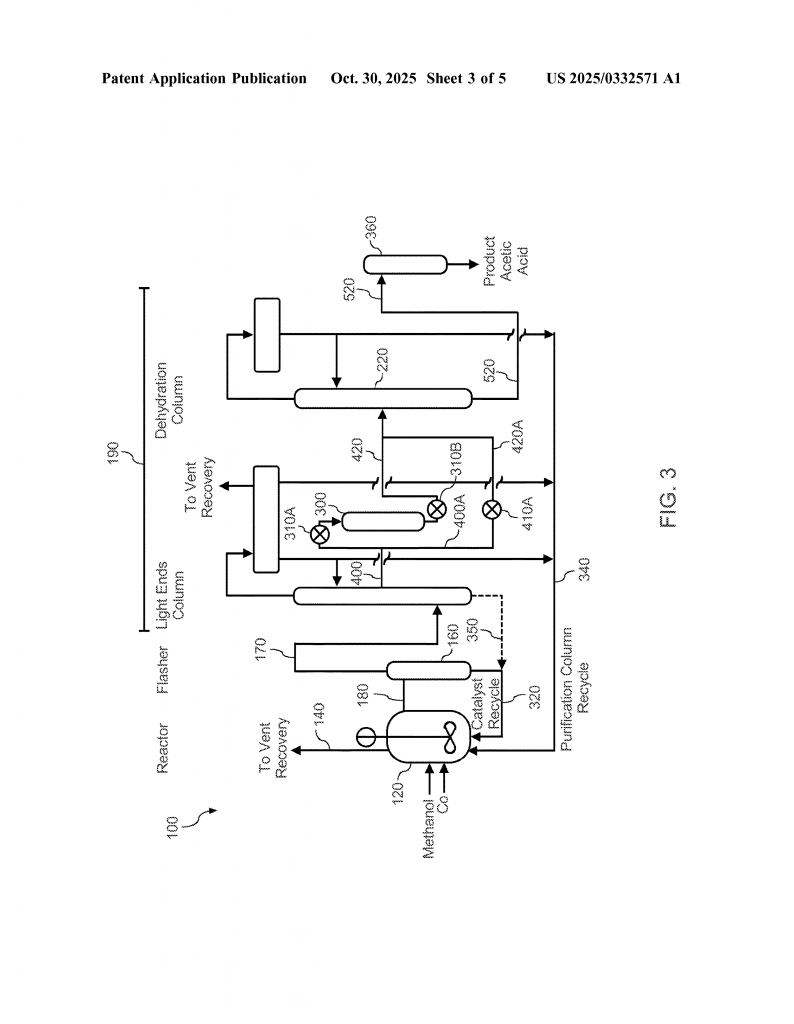
Testing and examples in the application show how different combinations of polymer, scavenger, and additives can be tailored for specific uses. The filters remain stable and effective even under tough conditions—like hot acetic acid in a chemical plant. Even when loaded with high amounts of scavenger or functionalized silica, the filters keep their shape and performance.
Perhaps most important, this invention makes it much easier and safer to handle chemical scavengers. There is less dust, lower risk for workers, and simpler logistics. The modular design means filters can be swapped in and out as needed, with minimal downtime.
Conclusion
This patent moves the needle for industries that need clean fluids. By bringing together smart material choices, careful engineering, and flexible design, it offers a strong, easy-to-use filter that can tackle a wide range of contaminants. The porous polymer composite filters solve problems of the past—dust, poor flow, hard handling—and open new doors for efficient, safe, and cost-effective purification. For anyone working with fluids in industrial settings, this invention offers a new tool to keep processes pure, recover valuable materials, and meet growing demands for safety and efficiency.
Click here https://ppubs.uspto.gov/pubwebapp/ and search 20250332571.