Invented by CHUNG; Sooyoon, NA; Jong-Hee, JANG; Byoungyoon, NA; Se Whan, PARK; Hyeonsu, LIM; Hyunwook, Samsung Electronics Co., Ltd.
Display technology is at the heart of our phones, laptops, TVs, and many other gadgets. As we demand higher quality and better performance from our screens, new inventions are needed to keep up. Today, we’re going to break down a recent patent application for a display device and its unique driving method, showing how it solves tough problems and makes screens look even better. We’ll unpack the background, the science, and the key new ideas in simple words, making it easy for everyone to understand.
Background and Market Context
Think about how you use your phone or computer every day. You want the pictures and videos to look sharp, bright, and smooth. As people want higher screen quality, companies have to make screens with more pixels. More pixels mean you can see tiny details and enjoy lifelike colors. But adding more pixels is not simple.
Inside every screen, there is a complex network of wires and circuits. Each pixel needs a signal to tell it what color and brightness to show. As screens grow in size and resolution, the number of these signals—and the chips that create them—keeps growing. This makes the main chip, called the source driver, much bigger and harder to fit inside slim devices. If you keep adding chips, the device gets thicker, uses more power, and costs more to make.
To keep screens thin and affordable, companies try to use fewer chips by having each chip do more work. One way is to make each amplifier in the source driver control more than one data line. This idea is called multiplexing. With multiplexing, the same piece of hardware can send signals to different parts of the screen at different times.
But multiplexing creates a new problem. When one amplifier switches between multiple lines, the way each pixel receives its signal can be different. Some pixels might charge up faster than others. Imagine pouring water into two glasses, but one glass fills up slower than the other. This difference causes lines or bands—called artifacts—to appear on the screen. These lines spoil the picture and lower the overall quality.
The market needs a way to keep screens thin and high-resolution, without sacrificing how good they look. This is where the new invention steps in. It’s designed to let each amplifier drive multiple data lines, but uses clever tricks to make sure every pixel lights up just right, removing those annoying lines and keeping images smooth and clear.
Scientific Rationale and Prior Art
To really get why this invention matters, let’s peek under the hood at how screens work, and what problems older solutions faced.
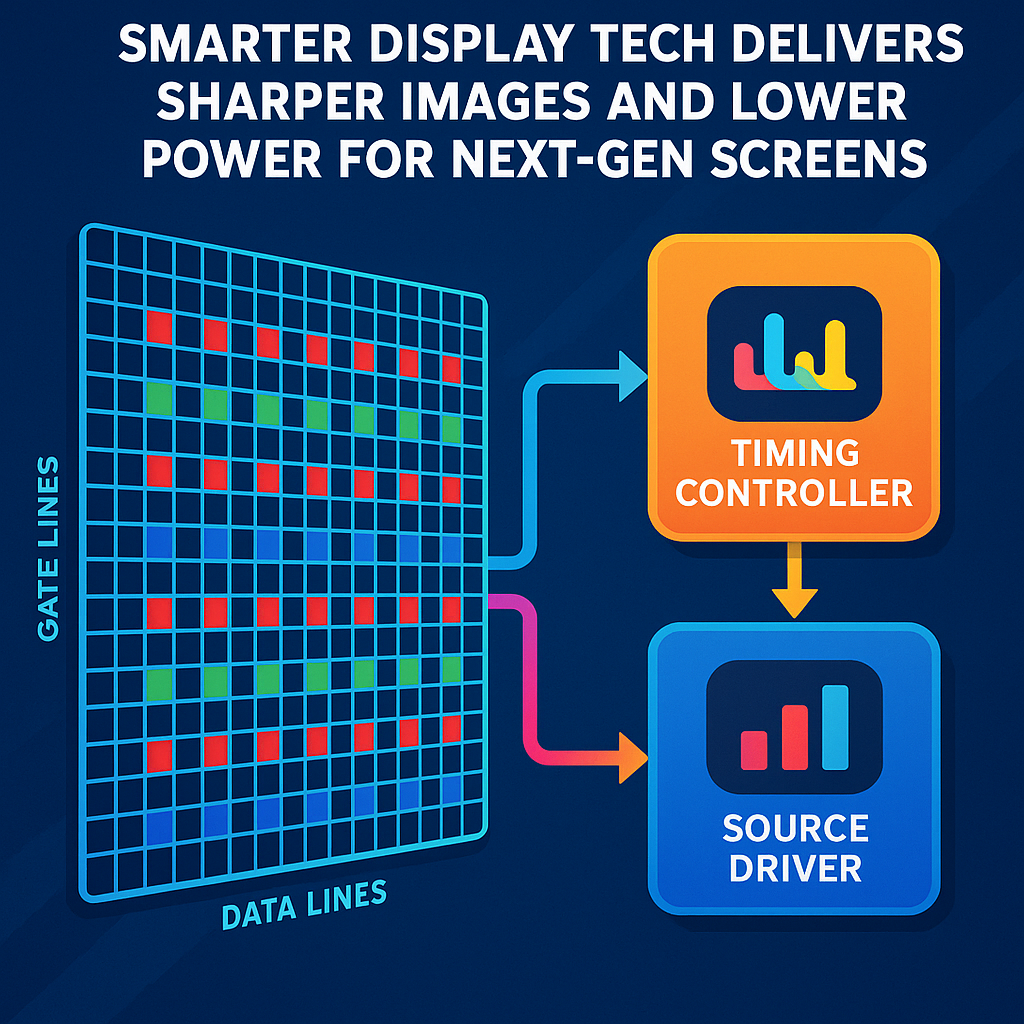
At the most basic level, every display has rows and columns of pixels. Each pixel is a tiny colored light that can be turned on or off by sending it an electric signal. There are two main types of signals: data signals (which set the color and brightness for each column) and gate signals (which pick which row is being written to at a given moment).
To make the screen show a picture, the source driver chip sends data signals through data lines. These lines connect to columns of pixels. The gate driver chip sends gate signals to select a row. When the right row and column meet, the pixel at that spot receives its data, stores it in a tiny capacitor, and lights up with the right color and brightness.
As screens grow, you need more data and gate lines. That means more amplifiers in the source driver. If you try to keep adding amplifiers, the chip gets huge. To avoid this, engineers invented multiplexing. With multiplexing, a single amplifier takes turns sending signals to different data lines at different times in a horizontal scan period.
But here’s the catch: multiplexing changes the way a pixel is charged. Sometimes, instead of getting its signal directly from the amplifier, the pixel receives it from a parasitic capacitor—a kind of temporary storage along the data line. This can make some pixels charge more slowly or with different voltage levels. When this happens across the screen, it creates visible lines or differences in brightness, especially where two data lines meet.
Many earlier inventions tried to fix this by adjusting the timing of when signals are sent, or by tweaking the hardware. Some patents introduce extra calibration steps or additional circuits to balance out the differences. Others try to slow down or speed up certain signals. But these fixes often add more complexity, more parts, and more cost.
Another idea is to use software to compensate for these issues. By adjusting the grayscale data—the information that tells each pixel how bright it should be—it’s possible to even out the differences. Some systems use lookup tables or compensation values based on the type of pixel (red, green, or blue) and its place on the screen. But these methods usually don’t account for changing conditions, like temperature or screen brightness, and can’t always keep up with all the variables.
Before this invention, there was no simple way to use multiplexing and still have perfect image quality. Something was always lost—either the screen was too thick, too costly, or the picture wasn’t good enough. The market needed a smarter approach, one that could adjust on the fly and work for any kind of display panel, without making the hardware much bigger or more complicated.
Invention Description and Key Innovations
Now let’s focus on the heart of this new patent: how it works, and what makes it special.
At its core, the invention is a display device with a clever driving method that combines hardware and software tricks to fix the problems caused by multiplexing. It keeps the source driver small by letting each amplifier drive more than one data line, but uses smart compensation to make sure every pixel gets the right signal.
Here’s how it works in simple steps:
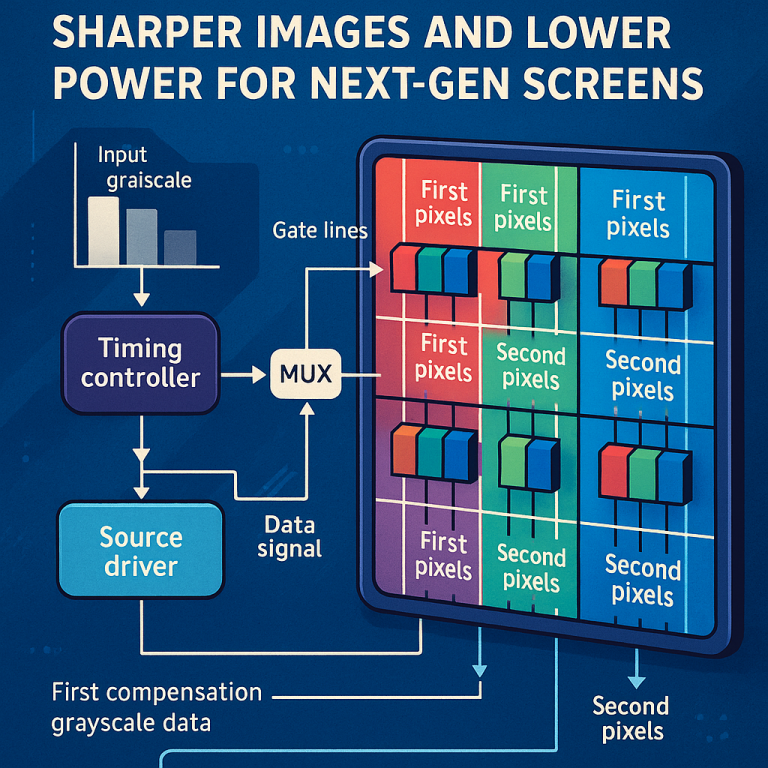
The display panel has lots of gate lines and data lines, just like before. Pixels are connected to these lines. Instead of giving each data line its own amplifier, the source driver uses multiplexing: it sends signals to one set of data lines during one part of the scan, and another set in the next part.
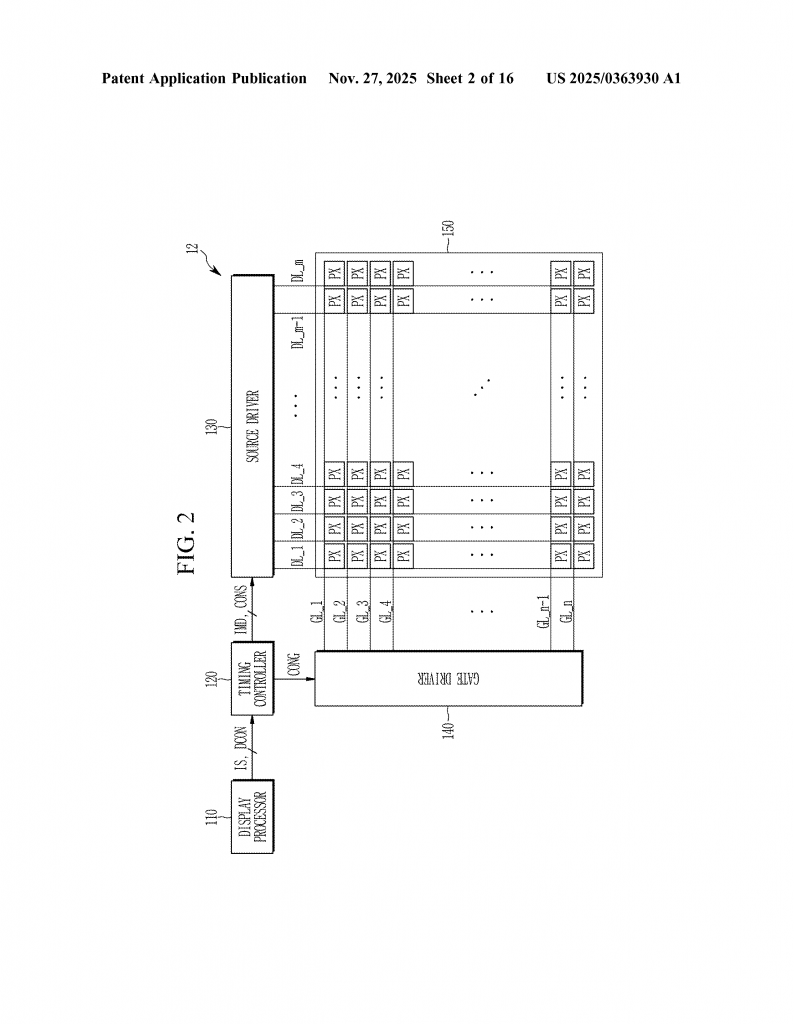
Some pixels get their data signal directly, while others get it through a parasitic capacitor. The big problem is that this can cause differences in how much charge each pixel gets, leading to those vertical lines or bands we talked about earlier.
The smart part of the invention is the timing controller. This is a brainy chip that watches over the whole process. It gathers information about how the display is being used—like the temperature, the brightness, and even the frequency at which the screen is working. These are called the “driving environment” factors.
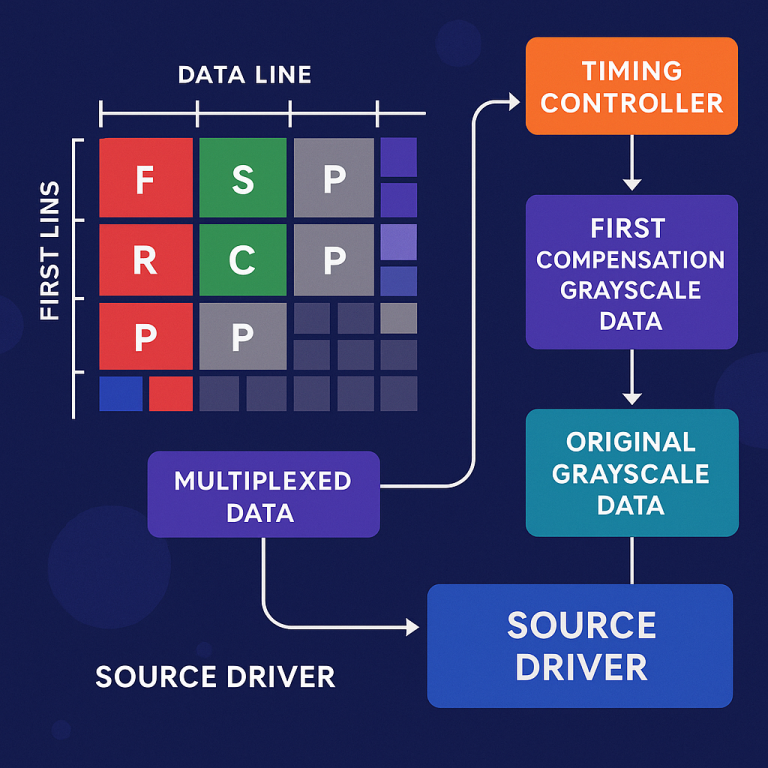
The timing controller uses this information to choose or create a set of compensation values. Think of it as a big table of numbers, with a value for every color and every possible brightness level. This table tells the controller how much to tweak the original grayscale data for each pixel, depending on what kind of pixel it is, and which data line it’s connected to.
But that’s not all—the controller is even smarter. If it can’t find a perfect match for the current driving environment, it picks two tables that are close, and blends them together, using a method called interpolation. This way, it always has the right values, no matter what’s happening with the screen.
When it’s time to send a signal to a pixel, the controller checks if the pixel is on a compensation data line (the ones affected by the parasitic capacitor). If it is, it adjusts the grayscale data by adding the compensation value. If it’s not, it leaves the data alone. It can also adjust the amount of compensation based on where the pixel is on the screen—the center might need a bit more tweaking than the edges, for example.
All these adjustments happen quickly, in real time, so the user never sees any difference. The screen looks smooth and even, with no unwanted lines or bands.
This method works for any kind of display panel: OLED, LCD, and more. It doesn’t need a bunch of extra hardware, so the device stays slim and affordable. By using software and a smart controller, the invention makes sure that multiplexing doesn’t ruin the picture.
The patent also covers different ways of organizing the data lines and amplifiers, so it can be used in lots of different screen designs. It describes how to create and use the compensation data, how to store it in memory, and how to adjust it on the fly as the display environment changes.
To sum up, the key innovations are:
– Using multiplexing to keep the source driver small, while fixing the problems it normally causes.
– A timing controller that collects environment data and uses flexible compensation tables, blending them as needed.
– Real-time adjustment of grayscale data for every pixel, based on color, location, and changing screen conditions.
– Support for many different screen designs, without adding bulky or costly hardware.
This invention brings together hardware and software in a new way, letting manufacturers build better screens that are thin, efficient, and look great—no matter how many pixels they have.
Conclusion
Display technology keeps moving forward, and this new patent shows how smart thinking can solve real problems. By mixing clever hardware design with flexible software control, the invention lets screens get bigger and better without the old trade-offs. The timing controller’s adaptive approach means every pixel shines as it should, and artifacts like vertical lines become a thing of the past. For anyone interested in how screens work—or how good ideas can make technology better—this invention is a great example. As more devices use high-resolution displays, expect to see this kind of solution making your favorite gadgets look clearer and brighter than ever.
Click here https://ppubs.uspto.gov/pubwebapp/ and search 20250363930.