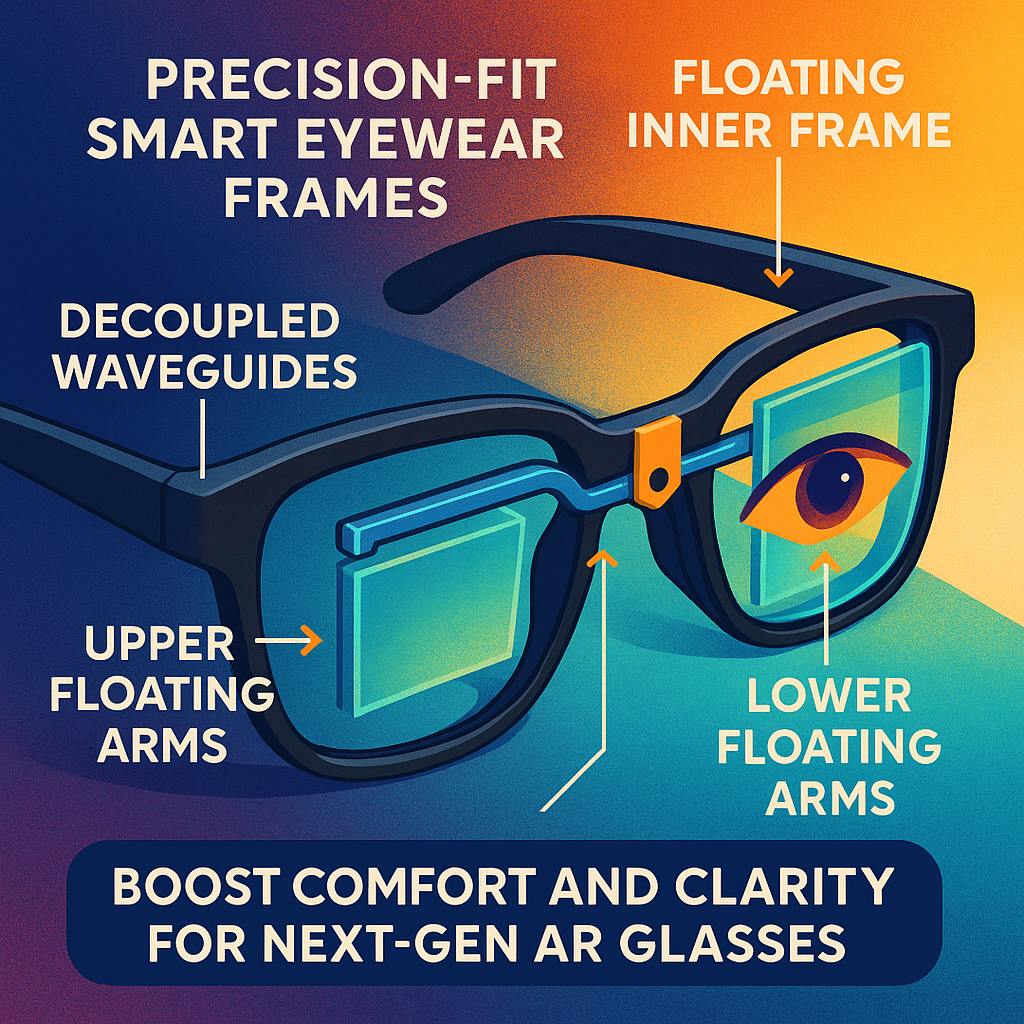
Invented by Ravindran; Srivatsan, Chen; Jerry Chung-Hung, Kossev; Peter, Valente; Matthew Thomas
Smart glasses and augmented reality headsets are everywhere in the news. Most people have heard about glasses that can show you directions, play videos, or even help you see things that aren’t really there. But making these glasses comfortable, light, and easy to use is still a big problem for inventors. A new patent application for a “Decoupled Waveguide Eyeglass Frame Assembly” may have found a clever solution.
Background and Market Context
Let’s start with why this invention matters. Augmented reality (AR) and mixed reality (MR) glasses are special eyewear that can show digital images right in front of your eyes, even while you look at the real world. They do this with displays hidden inside the glasses’ frames and lenses. These displays use tiny light sources and special glass pieces called waveguides to put images directly into your line of sight.
For years, tech companies have been racing to make AR glasses small and light enough for people to wear every day. Big names like Apple, Google, and Meta (Facebook) have all tried to build glasses that look and feel like normal eyewear. But there’s a problem: to make the glasses light and thin, the materials used in the frames often need to bend and flex. When the frame bends, even just a little, the delicate display inside can get misaligned. If the display is not perfectly lined up with your eyes, the digital images can look blurry, doubled, or just plain uncomfortable.

Imagine wearing glasses where the digital map or video floats a little off to the side, or you see two ghostly images instead of one. Not only is this annoying, but it can also give users headaches and make them stop using the glasses. For AR glasses to become something people use every day, the image quality must always be sharp and comfortable, no matter how the glasses are handled.
This market is huge. Millions of dollars are being spent to make AR glasses that look like regular eyewear, but with the smarts to overlay directions, messages, or even video games right onto your world. But to succeed, companies need to solve the alignment problem. If a new frame design can keep displays perfectly lined up, even when the glasses are flexed or dropped, it could become the new standard for all future smart eyewear.
Scientific Rationale and Prior Art
So why is alignment such a big deal in AR glasses? It all comes down to the way the displays work.
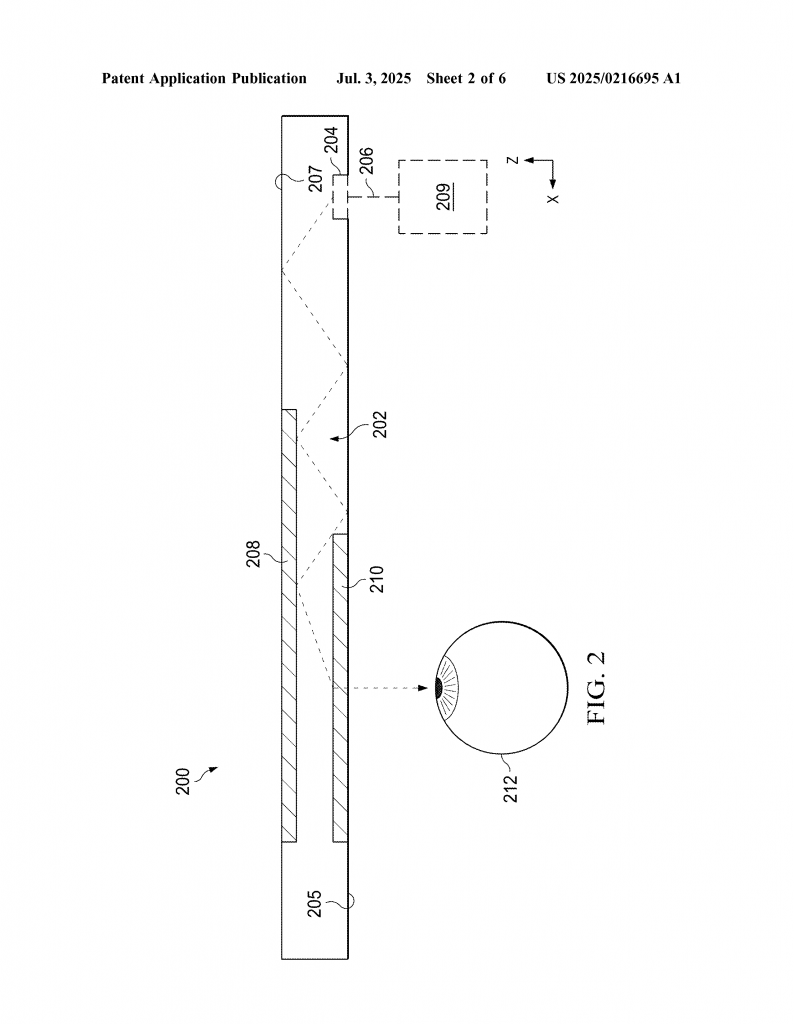
Most modern AR glasses use tiny screens or projectors hidden in the frame. The image from those screens is sent through a waveguide—a thin piece of glass or plastic with special optical structures inside. The waveguide works like a magic highway for light, taking the image from the projector and delivering it straight to your eye. Some waveguides use tiny grooves (called diffractive structures) to bounce light around inside the lens, so you can see the image floating in front of you.
For this system to work, every part—the projector, the waveguide, and your eye—need to be in exactly the right spot. If any piece moves even a little, the image looks wrong. In glasses with two displays (one for each eye), keeping both displays lined up is even more important. If one image is higher or lower than the other, your brain gets confused. This can cause headaches, eye strain, or even nausea. That’s why so much care goes into the mechanical design of AR glasses.
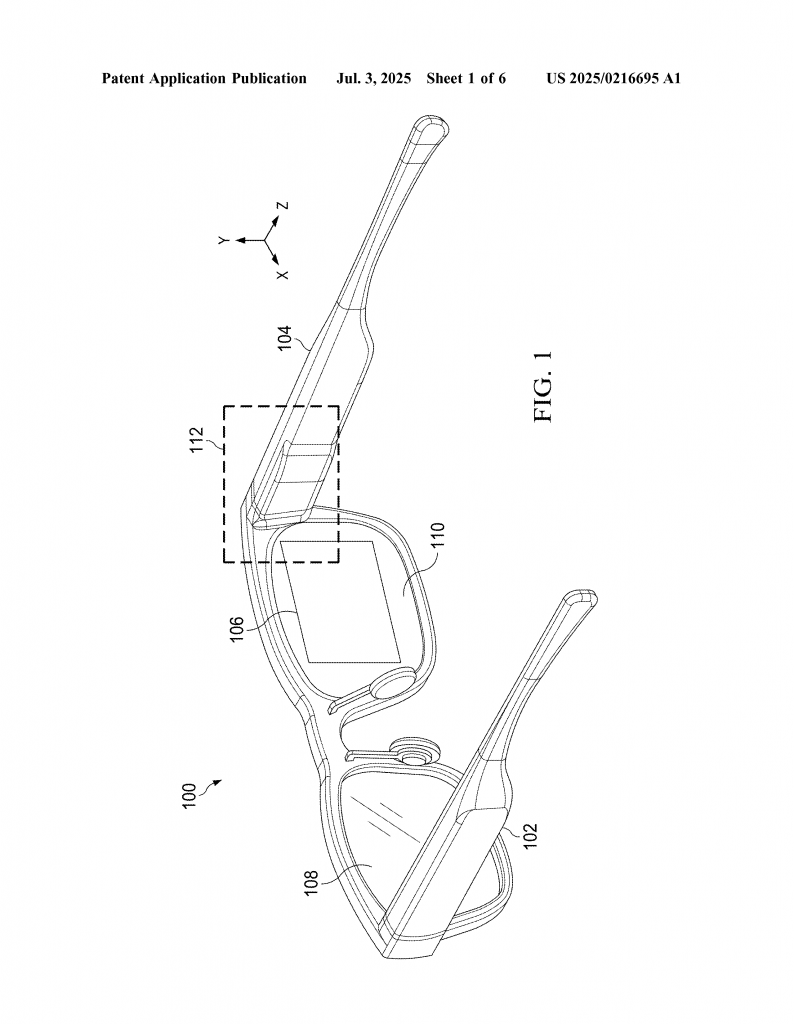
In older designs, the display and waveguide are attached directly to the outer frame of the glasses. The outer frame is often made from flexible plastic to keep the glasses light. But that flexibility is a double-edged sword. When you put the glasses on, take them off, or drop them, the frame can bend. When the frame bends, the display and waveguide move. Even the smallest movement can make the image look bad.
Some companies have tried to solve this by using stiffer, heavier materials for the frame. But this makes the glasses uncomfortable and bulky. Others have tried to add extra supports inside the glasses, but this adds weight and makes the glasses look strange. Some patents describe double frames or floating lens designs, but these don’t fully solve the problem of keeping the display perfectly aligned while still being light and comfortable to wear.
Until now, there has not been a simple, lightweight way to keep the waveguide and display perfectly lined up with your eyes, no matter how much the outer frame moves. That’s where this new invention comes in.
Invention Description and Key Innovations
This new patent application introduces a smart solution: a “decoupled” frame system for AR glasses. Let’s break down what that means, in simple terms.
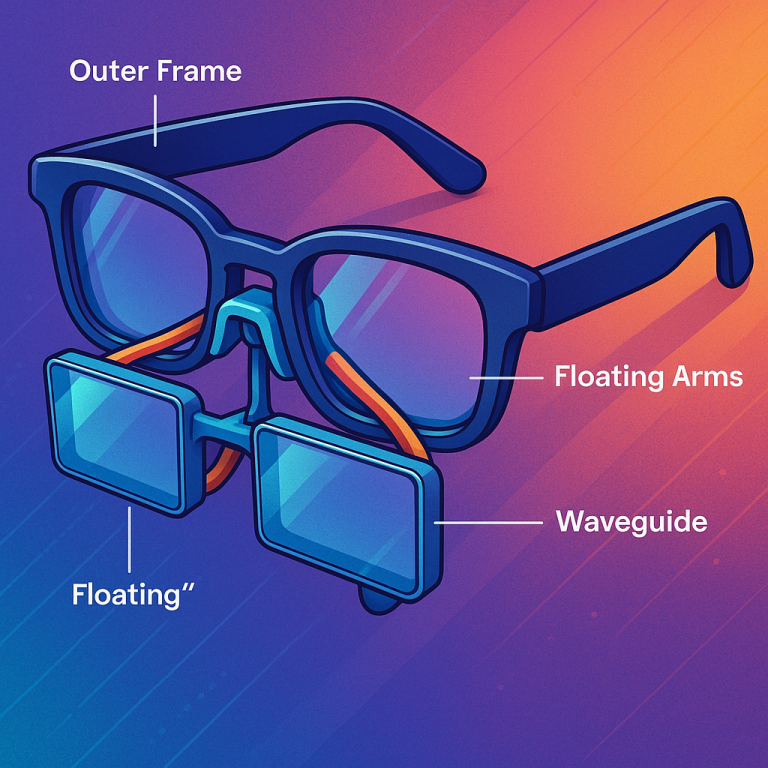
Instead of mounting the display and waveguide directly to the outer frame, this invention uses two frames. There’s an outer frame—the part you see and touch, which sits on your face and ears. Inside that, there’s a second, inner frame. This inner frame is called a “floating” frame because it is only attached to the outer frame at one small spot, near the nose bridge (the part that sits on your nose). Everywhere else, the inner frame is separated from the outer frame by a tiny gap. This means the inner frame can stay steady, even if the outer frame bends or flexes.
The display and waveguide are attached to the inner frame, not the outer frame. Special “floating arms” connect the inner frame to the lens and waveguide, holding them in the perfect position. Because the inner frame is only attached at the nose bridge—a part of the glasses that doesn’t move very much—the alignment stays true, even if you twist or bend the outer frame. The inner frame can be made from a strong, stiff material (like metal or hard plastic), while the outer frame can stay flexible and light.
This design has several big advantages:
First, it keeps the display and waveguide perfectly aligned with your eyes, no matter how much the outer frame moves. This means the digital images always look sharp and comfortable, with no double vision or blurriness. Second, if you drop your glasses or bump them, the outer frame can flex and absorb the shock, while the inner frame protects the delicate display inside. Third, because most of the frame is still lightweight plastic, the glasses stay light and comfortable for everyday use.
The patent describes different versions of this system. For example, the inner frame can have longer or shorter floating arms, depending on how much rigidity is needed. If the arms are shorter, the material must be stronger to keep things in place. The display can be glued or attached to the lens, and both the inner and outer frames can be made using 3D printing for custom fits or new shapes.
Another smart feature is the way the inner frame is connected to the outer frame. By attaching it only at the nose bridge, the rest of the inner frame is “floating” in space, surrounded by a tiny gap. This gap lets the inner frame move a little, acting like a shock absorber if the glasses are dropped. It also means that any flexing or bending of the outer frame doesn’t get transferred to the inner frame and the display, keeping everything in perfect alignment.
This invention can work for both binocular (two-eye) and monocular (one-eye) AR displays. Even if there’s only one display, the inner frame keeps it lined up with your eye, for a clear and comfortable image.
Finally, the patent covers ways to manufacture the frames and lenses, including using adhesives, overmolding, or even advanced 3D printing. This makes it easier for companies to create lightweight, strong, and perfectly aligned AR glasses for all kinds of users.
Conclusion
The decoupled waveguide eyeglass frame assembly is a clever new idea for making AR glasses work better. By “floating” the display and waveguide on an inner frame that is only attached at the nose bridge, it solves one of the biggest problems in smart eyewear: keeping the image sharp and clear, no matter how the glasses are handled. This design lets the outer frame stay light and flexible, while the inner frame keeps the display perfectly lined up with your eyes. The result is glasses that are more comfortable, more durable, and better for showing AR images. This invention could set a new standard for all future smart glasses, helping make AR eyewear something people will actually want to wear every day.
As more companies race to make the best AR glasses, small changes like this “floating” frame design can make a big difference. By focusing on comfort, alignment, and durability, this patent may help bring the next wave of wearable tech to everyone. With a simple but powerful idea, the future of smart eyewear is looking clearer than ever.
Click here https://ppubs.uspto.gov/pubwebapp/ and search 20250216695.