Invented by Fedoruk; Roman, Manton; John, Reagan; Spencer, Roberts; Gregory, Stuntebeck; Erich
Today, companies are racing to use artificial intelligence (AI) to gain an edge. But for many, especially small and medium businesses, building and running AI systems is not easy. As AI tools get more powerful, they also get more complex. Managing all these moving parts can be a real headache, especially when many different users or “tenants” are using the same system. A new patent application tackles this problem head-on, laying out a smarter way to manage AI pipelines in a multi-tenant world.
Let’s break down what makes this approach unique, why it matters, and how it could change the way organizations use AI—making it easier, safer, and more affordable for everyone.
Background and Market Context
AI is everywhere—from chatbots and search engines to healthcare and finance. But behind every smart app is a complex “pipeline.” These pipelines are like assembly lines. They take in data, clean it up, run it through models, and then spit out answers or predictions. For big tech companies with lots of resources, building these pipelines is doable. For smaller companies, it’s a huge challenge.
Many businesses use shared AI platforms. Think of these platforms as apartment buildings. Different companies (tenants) rent their own space but share the same utilities, like water and electricity. In the AI world, these “utilities” are things like computing power, storage, and software tools. Each tenant wants privacy, control, and easy ways to build their own AI systems, without stepping on their neighbor’s toes.
But here’s the problem: managing all these different tenants is really tough. Each one might need different tools, models, or data. Security is a big deal—no company wants their data leaking to another. Costs can spiral out of control if resources aren’t managed well. And as new AI tools appear almost every day, keeping everything up-to-date is a never-ending job.
The market is hungry for a platform that makes it easy for any company to use AI without needing a team of experts. Businesses want to pick and choose the tools they need, try out new features before buying, and only pay for what they use. They want simple ways to control who can access what, and they want to be sure their data is safe.
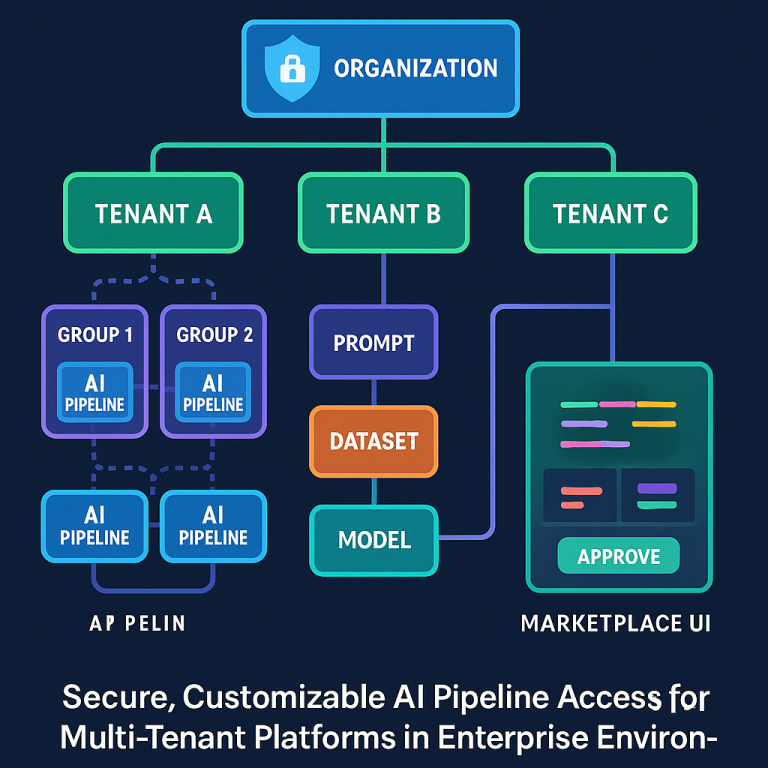
That’s where this new patent comes in. It describes a system that lets companies—and even their customers—build, test, and manage AI pipelines with fine-tuned control. It lays out how to organize users, groups, and permissions so everyone gets just the right amount of access. It even adds a marketplace, so tenants can browse and purchase new AI models or tools, try them out, and get approval before committing. This approach promises to lower costs, boost security, and make powerful AI tools available to everyone.
Scientific Rationale and Prior Art
To understand why this patent is a leap forward, it helps to see what’s come before. Traditionally, AI pipelines are built by experts—data scientists and engineers who stitch together lots of tools. These pipelines are often “one size fits all,” built for single users or single organizations. When more users are added, things get messy. Permissions are hard to manage. Different teams might accidentally overwrite each other’s work. Security gaps can appear if someone gets the wrong access.
Some cloud platforms already offer “multi-tenancy.” This means several customers can use the same platform, but their data and tools are kept separate. However, these systems are often rigid. If a tenant wants to try a new model or dataset, they might need to ask an administrator to set it up. Testing new features is slow. And there’s little flexibility in how permissions are managed. For example, one user might get too much access, while another is blocked from tools they need.
Other platforms use “role-based access control” (RBAC), but these systems can be hard to scale. If you have hundreds of users across dozens of tenants, managing who can do what becomes a nightmare. And if a tenant wants to give a specific group access to one tool but not another, it gets even more complicated.
Some tools let users build pipelines with drag-and-drop interfaces. Others offer marketplaces for AI models. But rarely do these features work together in a way that’s simple, secure, and scalable for lots of different tenants.
The scientific challenge is to design a platform that is flexible enough for different needs, but strong enough to keep everything secure and manageable. It should let tenants easily add, remove, or test pipeline tools—without risking cross-tenant data leaks, and without needing an expert to configure everything.
What sets this patent apart is its detailed permissions hierarchy. It defines not just organizations and tenants, but also groups within tenants, each with their own customizable permissions. It adds a dynamic user interface that updates what each user can see and do, based on their profile and permissions. It brings in a marketplace, where tenants can discover, try, and buy new pipeline tools—with approval workflows to keep spending and security in check. And it automates many of the tasks that used to require manual setup, reducing the need for specialized staff.
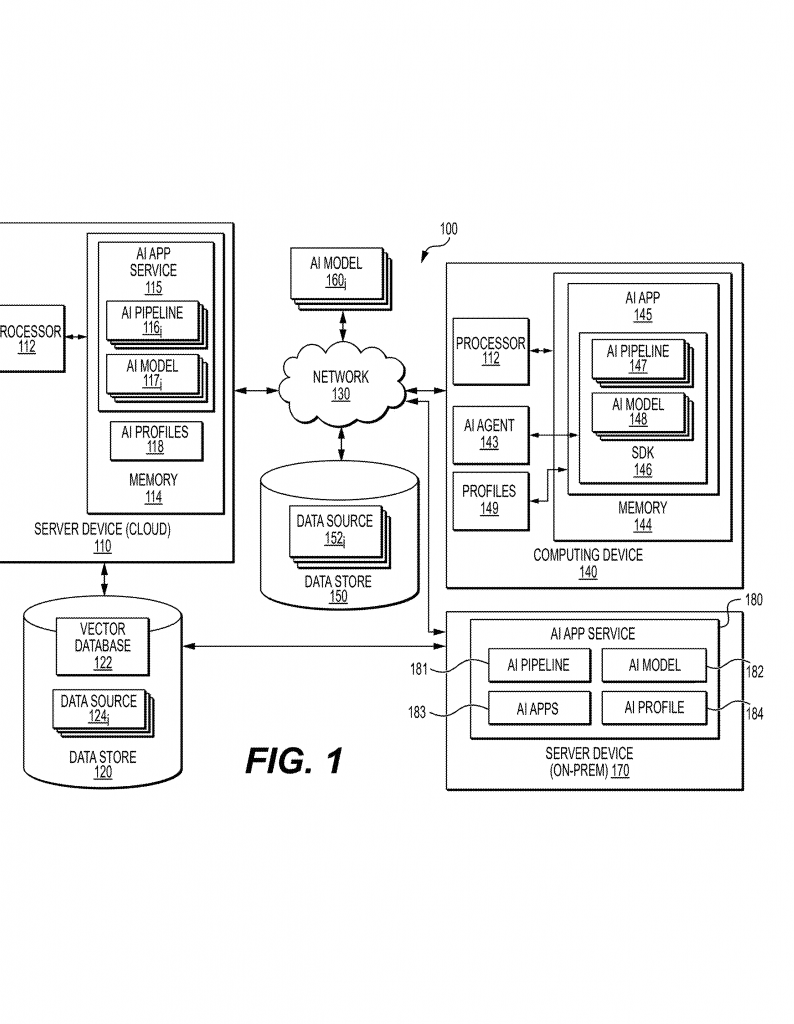
Compared to prior art, this approach is more granular, more dynamic, and more user-friendly. It combines the best of pipeline design, access control, and marketplace features—all in one platform.
Invention Description and Key Innovations
Let’s get into the nuts and bolts of the invention. At its heart, this patent describes a way to manage AI pipelines for many tenants, with fine-grained control over what each user, group, and tenant can do.
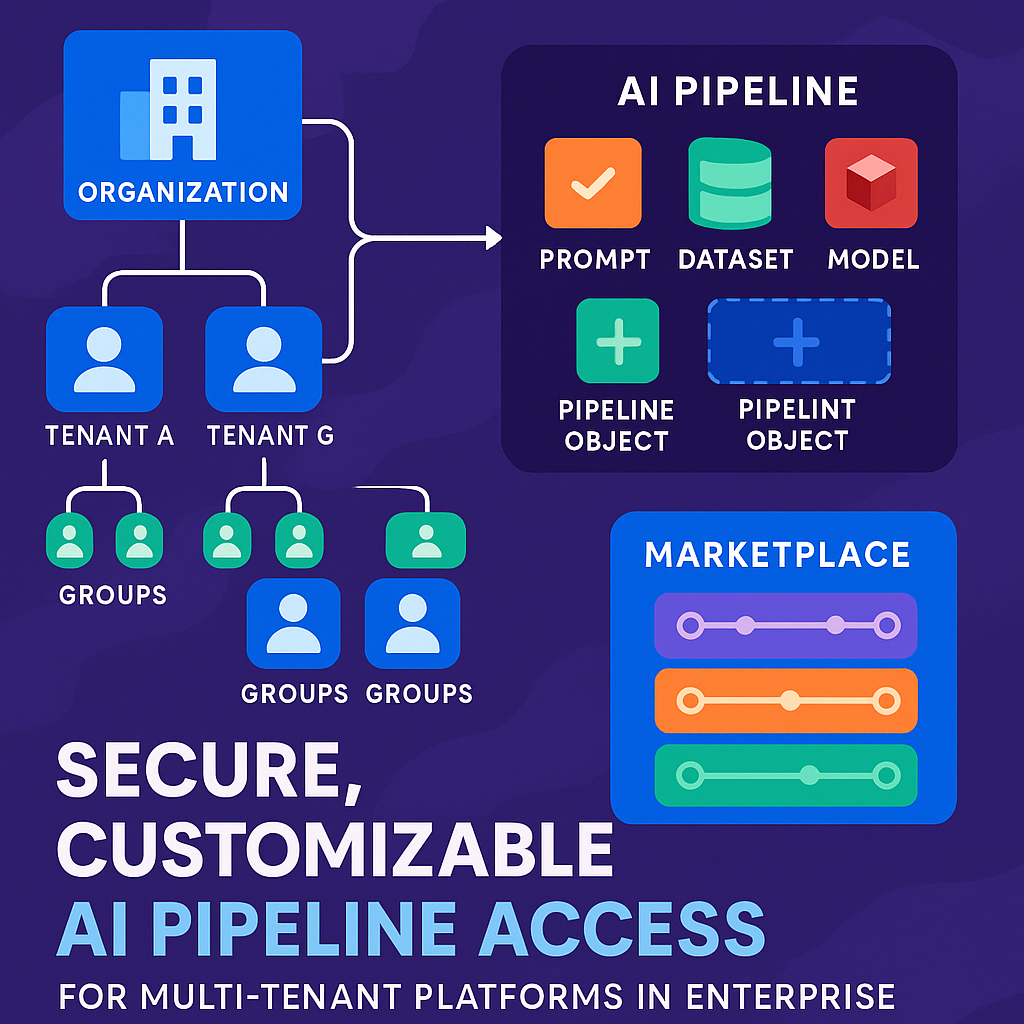
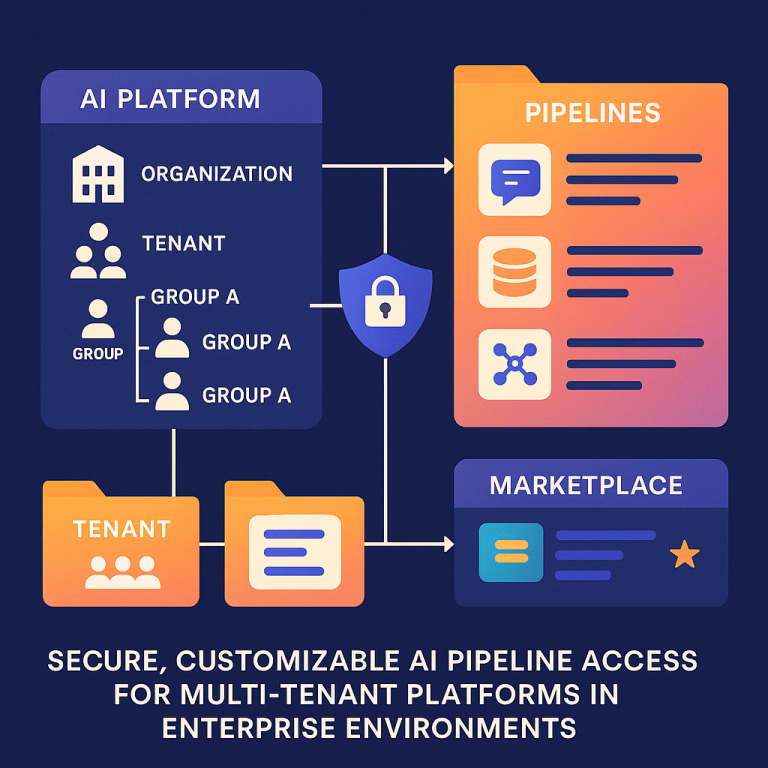
The system starts by organizing everything into a hierarchy:
1. Organization: This is the top-level “owner”—say, a company. It sets the main permissions and owns the main resources (models, datasets, pipelines).
2. Tenants: These are subdivisions under the organization. Each tenant can be a different department, partner, or even a customer of the main company. Tenants get a slice of the organization’s resources, but only what they’re allowed to use.
3. Groups: Inside each tenant, you can have groups (like teams or project units). Each group can have its own special permissions, so only certain people can access certain tools or data.
4. Users: Each user is assigned to an organization, tenant(s), and group(s). Their access is controlled by all these levels.
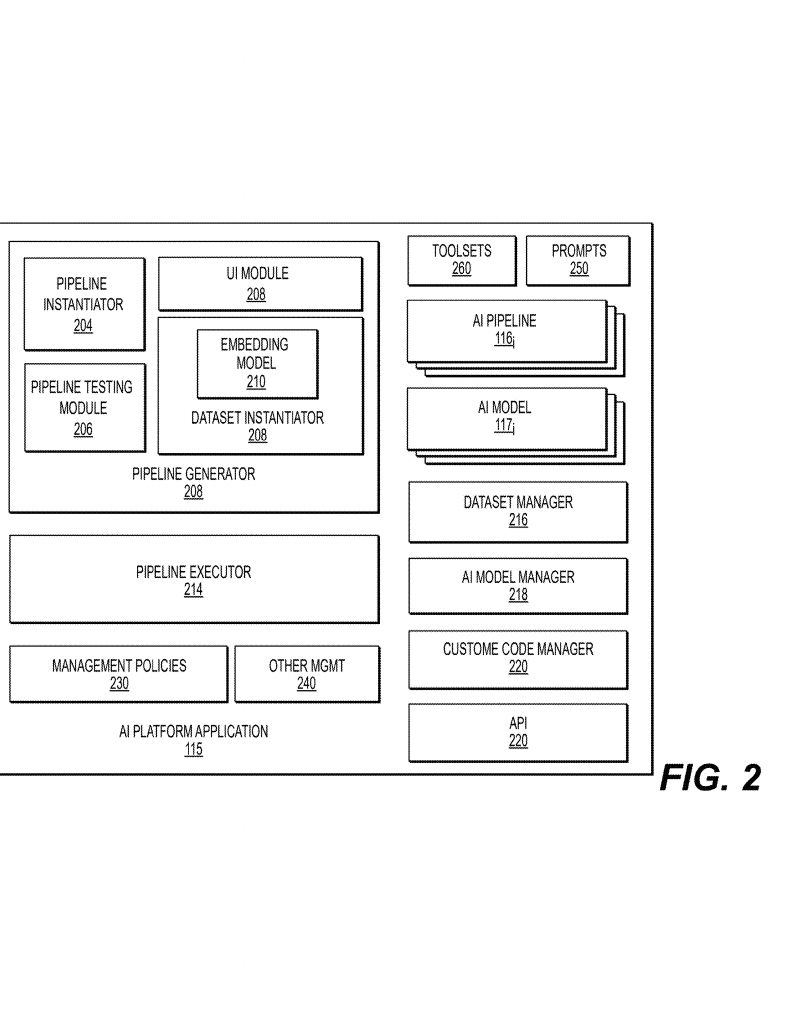
The patent explains how, when a user logs in, the system checks their profile. The user interface (UI) then shows only what that user is allowed to see—pipeline objects, models, datasets, prompts, and so on. If they switch tenants using a selector, the UI updates to show only the tools for that tenant. The server blocks users from mixing resources across tenants, keeping data and permissions cleanly separated.
The pipeline designer is a highlight. It’s a drag-and-drop UI where users can build AI pipelines by connecting objects like models, datasets, and prompts. The UI only shows pipeline objects the user is allowed to access, based on their group and tenant permissions. The system also supports testing (“playground” and “battleground” modes), so users can see how changes affect the pipeline before deploying them.
The marketplace brings another layer of value. Tenants (or users with the right permissions) can browse new pipeline objects—models, datasets, tools—from the marketplace. The UI smartly prioritizes items that match the user’s permissions and are compatible with their existing pipelines. Users can simulate how a new object will perform before buying. If a user wants to purchase an object, the system can require approval from an admin, adding a safety check before spending money or changing the pipeline.
Security and compliance are built in at every level. The system can enforce rules based on location, device status, or time. For example, a dataset might be accessible only when the user is in the office, or a model might be blocked if the user’s device isn’t secure. The system also tracks usage and logs activities for audits.
Advanced features include:
– Version control for pipelines, so changes can be rolled back.
– Support for importing and exporting pipelines between tenants (with approvals and security checks).
– Automated cost control, with the system suggesting cheaper models or scheduling jobs at lower-cost times.
– Fine-grained approval flows for marketplace additions.
– Automatic suggestions for pipeline improvements, based on usage and new marketplace offerings.
The whole platform is designed to be white-labeled, so companies can offer it to their own customers as a branded service. This means even small companies can act like big tech, offering advanced AI tools to their clients without building everything from scratch.
In summary, the invention’s key innovations are:
– A dynamic, multi-level permissions system (organization, tenant, group, user).
– A UI that updates in real time based on user permissions and selections.
– Integration of a marketplace for discovering, testing, and purchasing pipeline tools, with approval workflows.
– Secure isolation between tenants, with easy migration and export/import.
– Automation of common tasks like cost control, compliance, and pipeline versioning.
– Tools for admins to monitor, audit, and optimize usage across all tenants.
For businesses, this means faster onboarding, safer operations, and a lower barrier to AI adoption. For users, it means more power with less hassle—building, testing, and customizing AI pipelines without needing to be an expert.
Conclusion
AI is reshaping every industry, but not every company has the time, money, or expertise to keep up. This new patent points the way toward a smarter, more accessible future. By breaking down the barriers to building and managing AI pipelines—especially in multi-tenant environments—it levels the playing field. Even small teams can now use advanced AI tools, safely and efficiently, with just a few clicks.
The real genius of this invention is its focus on practical, real-world needs: clear permissions, easy pipeline design, a built-in marketplace, and strong security. For organizations looking to get ahead with AI, this approach offers a simple truth: you don’t need to be a tech giant to use world-class AI. You just need the right platform.
Click here https://ppubs.uspto.gov/pubwebapp/ and search 20250363548.